Advertisements
Surprising uses of 3D printing in medicine They mark one of the most profound and tangible changes within the health sector in the last decade.

What began as an experimental technology now impacts diagnostics, surgeries, rehabilitation, and medical training with measurable and clinically relevant results.
This article analyzes, with rigor and a current focus, how 3D printing is redefining medical practice in 2025.
Summary
- Why 3D printing became key in medicine
- Personalized medicine: from patient to treatment
- Clinical applications that are already saving time and lives
- Real benefits compared to traditional methods
- Ethical, technical and regulatory limits
- The immediate future of medical 3D printing
- Conclusion
- Frequently Asked Questions
3D printing as a turning point in modern medicine
Surprising uses of 3D printing in medicine They do not represent a futuristic promise, but an increasingly integrated clinical practice.
Advertisements
Unlike other digital innovations, this technology directly impacts the human body, surgical precision, and patient recovery.
From personalized prosthetics to anatomical models for surgical planning, 3D printing offers something that traditional medicine rarely achieves: tailoring treatment to the individual, not the average.
Its relevance lies in its ability to reduce errors, optimize time, and improve clinical outcomes.
Medical personalization: the true value of 3D printing
Contemporary medicine is moving towards personalized approaches.
In this context, 3D printing functions as a key tool to transform medical images into physical and functional solutions.
CT scans and MRIs allow for the creation of accurate models of organs, bones, or blood vessels.
These models help doctors plan complex interventions more safely.
So, Surprising uses of 3D printing in medicine They are directly linked to more precise and humane care.
Personalization not only improves clinical outcomes; it also strengthens patient confidence in the procedure.
Clinical applications that are already a reality
Anatomical models for complex surgeries
Surgeons use 3D printed replicas to rehearse procedures before entering the operating room.
This practice reduces operating times and minimizes risks, especially in cardiovascular and neurological surgeries.
Customized prostheses and orthoses
3D printed prostheses are adapted to the exact anatomy of the patient.
Unlike standard models, they offer greater comfort, better mobility, and less adaptation time.
Advanced digital dentistry
Dental clinics are using 3D printing to manufacture aligners, surgical guides, and crowns with high precision.
The result combines aesthetics, functionality and speed in treatments.
Practical example 1: Safer cardiovascular surgery
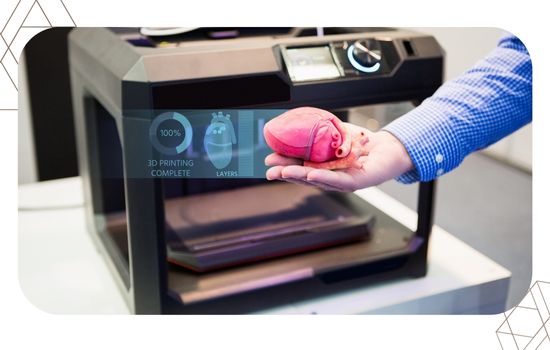
A university hospital in Latin America incorporated 3D printing to create exact models of hearts with congenital malformations.
Before the surgery, the medical team rehearsed the procedure on the physical model.
The actual procedure was completed in less time than average and with less intraoperative risk.
This type of application illustrates how Surprising uses of 3D printing in medicine They generate concrete clinical benefits, not just abstract technological advances.
Table: Current medical applications of 3D printing
| Medical area | Main application | Clinical benefit |
|---|---|---|
| Surgery | Anatomical models | Greater accuracy |
| Orthopedics | Customized prostheses | Better adaptation |
| Dentistry | Guides and aligners | Quick treatments |
| Rehabilitation | Custom-made orthotics | Greater comfort |
| Medical education | Simulators | Practical training |
Read more: Renewable energy and technology: towards a greener future
Real benefits compared to traditional methods
3D printing does not completely replace existing medical techniques, but it does offer clear advantages:
- Exact adaptation to the patient
- Reduction of surgical times
- Improved clinical planning
- Optimization of hospital resources
- Greater understanding of the procedure by the patient
As an analogy, 3D printing in medicine is like a tailor-made suit versus a one-size-fits-all suit: both do their job, but only one truly fits the wearer.
Practical example 2: personalized rehabilitation
A rehabilitation center designed 3D-printed splints for patients with neurological injuries.
Each device was adjusted to the user's morphology and progress.
Therapists observed greater adherence to treatment and faster functional improvements compared to standard devices.
This scenario demonstrates that Surprising uses of 3D printing in medicine They also have an impact on processes following diagnosis and surgery.
Scientific evidence and relevant data
According to a study published by The New England Journal of MedicineSurgical planning with 3D printed models can reduce operating time by up to 20% in complex procedures, depending on the type of surgery.
This reference supports the real clinical value of the technology, beyond the media enthusiasm.
Ethical, technical and regulatory challenges
Although the progress is evident, a critical perspective is necessary. Medical 3D printing faces significant challenges:
- Strict regulations for implants and devices
- High costs for biocompatible materials
- Need for constant clinical validation
- Specialized staff training
Ignoring these factors can create unrealistic expectations.
The strength of Surprising uses of 3D printing in medicine It lies in its responsible and evidence-based application.
The immediate future: what to expect in 2025 and beyond?
Bioprinting, the printing of living tissues, is still in the experimental phase, but it is already showing progress in skin, cartilage, and simple structures.
In the short term, the integration of 3D printing with artificial intelligence will allow for even more precise designs and automated processes.
Medicine advances not only through technology, but also through well-informed clinical decisions.
In that sense, 3D printing will continue to grow where it provides real value to the patient.
How far will this unprecedented medical personalization go?
Conclusion
Surprising uses of 3D printing in medicine They reflect a profound, measurable, and patient-centered transformation.
This technology redefines how surgeries are planned, medical devices are manufactured, and rehabilitation is conceived.
It is not about replacing traditional medicine, but about enhancing it with more precise, humane and efficient tools.
Clinical evidence supports its gradual and strategic adoption, always under clear ethical and regulatory standards.
Read more: 3D printing: how it's revolutionizing the industry
Frequently asked questions about 3D printing in medicine
Is 3D printing safe for medical use?
Yes, provided that the materials and processes comply with health regulations and clinical validation.
Can all hospitals use 3D printing?
Adoption depends on resources, training, and specific clinical needs.
Are whole organs currently being printed?
Not for functional transplants. Bioprinting is still under investigation.
Does 3D printing reduce healthcare costs?
In many cases, yes, especially by reducing surgical times and optimizing treatments.
Grasp Surprising uses of 3D printing in medicine It allows us to observe how technological innovation, when applied with clinical judgment and scientific evidence, improves healthcare and redefines the future of medical care.